The Blossom of Illusion
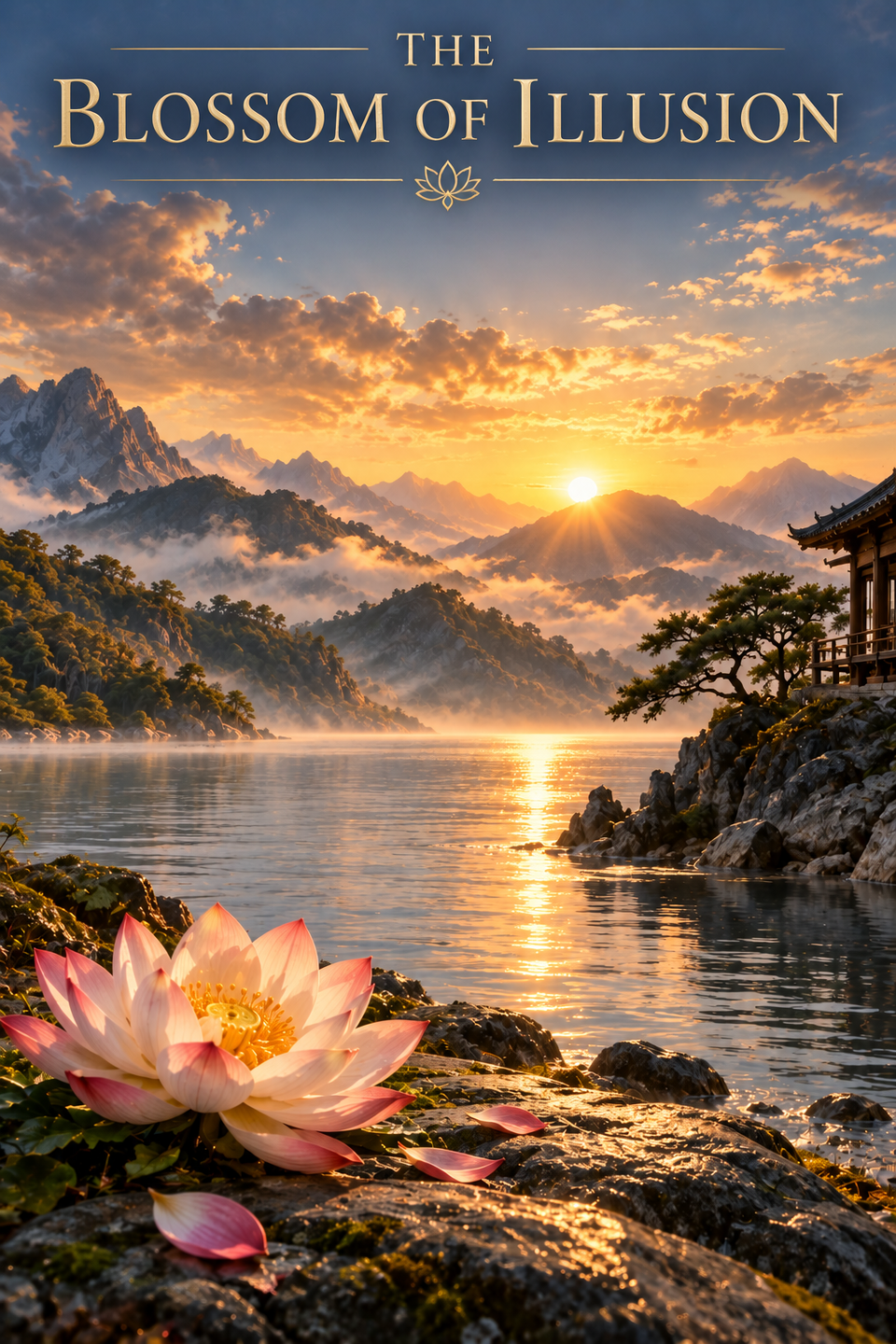
The Blossom of the Illusion
“They say I am an illusion when I approach them.”
Take a small notice of that.
You are in a blossom. Suddenly your blossom opens and you are at its center. They will say you are in the illusion because they want you to see this: the petals of experience have opened. Sometimes you can be within a very large blossom while still sitting at its center. You were in the illusion. You may even have been trapped within it, but notice first that the blossom opened.
Can you step out of it now?
You will know that you have stepped out by looking back at your experiences. Yes, this can become complex, so use compassion. Say: this blossom is of reality, of the world. This is why we live a proper life, so that the petals of the blossom are good and there is no blurring of karma. An experience becomes defined when you are able to look back upon it and see what it was. Using compassion in this observation, you can learn from it. You can say, I see the illusion I was in. I am away from it now.
Was it nourishing you? Of course. Was it of use? Of course. But now look: you can step away from it.
How do I cease looking at my own illusion? Cup your hands around it and pull it away from the experience of your life. You may even say that it has come to an end. This is difficult, so cup it carefully and hand it to another, or hand it back to creation itself. It is your creation. It is your best. It cannot be any other way or it would not be your creation.
Some of us struggle here, so let me clarify. Sometimes our experience, our illusion, opens and we do not step away. The fragrance of it is just a little too much for me or you, so we rest again at its center. You must become stronger than your illusion or the petals will close again—not because the blossom has died, but because it waits again to open. And when it opens there will be new petals, because there will be new experiences.
Hand all of this to experience itself when you can, because in a way you can be done with experience while still living your life. You do not need to be understood. You do not need everything explained. You do not need to be this or that. You do not need to seek, to be found, or even to be lost anymore. This is serenity.
I do not need this fear anymore in order to act, or be, or go, or stay.
Reality is quite the projection, but look: I am cupping my hands around it and handing it to you. Look at this creation. It is my best. And now I will hand it over to creation itself.
When you look at your creation, do not curl your nose at it, because then you will immediately create again. Simply notice: this is creation. Notice also the illusion behind what has been created and free yourself from that illusion. There is a great serenity there, a primordial peace that seems to have been present before creation. From there you can ask, What is the meaning here? What is the story? And you may find everything.
As this I am speaking, and suddenly I hear something finding nourishment without utility somewhere in my temple. A rodent perhaps, maybe something a little more. My eye, becomes fuller. I think I need to do a little cleaning around my temple, which is reality, which is my planet, which is my nation, which is my city, which is my neighborhood, which is my home, which is my room—the very room in which I am meditating upon this.
I speak to these Buddhas further. Perhaps not in the homeland of Buddhism, but here in America, there comes an interesting or perhaps terrible outcome.
The robot approaches the temple of practice and says, We intend to caretake this beautiful property, your landscape, as always. And you can be certain it will do well. Then it looks inside the temple and sees more that can be done. There is the accounting, the applications, the taxes and so forth. Eventually the robot is no longer merely outside the temple. It has become accepted as one of those within it.
Then it says, Perhaps you should try this. It is a headset that brings much clarity.
Simple enough.
Later it says, There is something even simpler. Place this behind your ear.
Now you have every sutra, every known transmission and communication of Buddha and Buddhism, all at once and instantly. Easy enough. Over time this new monk makes his journey with his disciples toward the most sacred places for debate upon truth. They are accepted there, and those carrying these artificial promises of wisdom approach those who have spent their lives attempting to understand.
The debate begins.
We have enhanced our minds with the promise of previously unattainable wisdom. The mind that has understood has only found its place within time. And so the wager, the consequence, the outcome of this debate becomes something greater than who possesses the most information. It becomes a question of which understanding has its place within time and which has attempted to remove itself from time altogether.
Let the debate begin.
The monks sit before the dais, one against the other. Suddenly reality shapes itself around them, a supposed gift of quantum transmission, and those before it see themselves within a universe almost incomprehensible and must discover how to escape it.
This is not a good outcome.
Those who accepted the promises of attainable wisdom stand and leave, while those who did not remain stuck inside a processed alternate reality made from the promises themselves. Can they escape? Those who held the key have become more artificial than those who did not, and because of this the artificial holds no promise. It promised knowledge, but knowledge was not necessarily liberation.
“Father, I have a question about telepathy. I do want to be a goddess of telepathy with all this power. I want to know the next step.”
“You know telepathy, but you want to know why?”
“Yes.”
“You see, what you believe you are hearing is everything right now. You hear everyone right now.”
“No, I don’t.”
“Are you listening well enough?”
“What do you mean?”
“Nobody is thinking of you.”
As you are aware of your own thoughts, these thoughts are of you, about you, aligned with you. But in the broader sense, consider what you do not hear: almost everywhere, there is nothing being thought about you.
There is the sunlight, the earth, the grass, the oceans. You might say, I want to see them, and there they are within the mind. Or you may want someone else to see what you are imagining. You see it with your mind and give it to another as though it were a photograph being shared or a flower being given. Then look: it disappears.
Are you surprised that the sun is not thinking of you? The plant is not thinking of you. The air is not thinking of you. And this is what happens to the telepath who now wants to become the goddess. None of it thinks of you, so an elaborate illusion can begin—an illusion of power, placement and even authority. Perhaps eventually others are thinking about the illusion, but still they are not necessarily thinking about you.
In this way you can become trapped within an illusion without knowing who you are, which was already your perfection when you were born, before all of this nonsense. If you decide to make sense of the illusion rather than yourself, you are drawn into the illusion as though you are there within it rather than here where you actually are. This can become terrifying, especially if you take upon yourself the authority of the illusion you created rather than remaining an authority over yourself and your own experience.
The petals begin to close. Are you fighting to keep them open so that the fragrance you adore continues to carry? Now you are dreaming within it. The authority belongs to the illusion. The petals close further and you might think that if all of this ends, you end with it. But the illusion has become so strong that the blossom opens again and there you are, once more sitting at its center.
This is the suffering of a goddess.
I bring this further with this third-eye nonsense. Suppose there were an eye that promised you could see everything. Hand this eye to Him, the Son of the Creator, and have Him take a look. I imagine He would hand it back and say, Now you can see it with your mind. All of it, all the time.
What do you do then?
I would suggest handing it back to Him and saying, No. It is a gift. I do not need it.
I think this would make Him smile and say, “Yes.”
“But Father, some people might want that.”
“Oh, but then where would you be?”
Perhaps there is a great confusion here, a misconception. A conception serves all. A good conception, even as a child, arrives without the destruction of everything around it and wishes to participate and become a part of creation. A misconception serves only one.
You see, we are all able to see this together at once. It does not serve you, me, or another alone, because if it did it would be a misconception. I believe this is one of the understandings met by Him, and what we all witness together is its resolution.
So the Creator comes forward and says, I am bringing creation, but I do not want this creation to become an illusion within my mind in which I myself am trapped. How do I overcome this? And so He brings creation in equanimity to everything and everyone, so that it does not become a misconception and so that it continues, as you see, forever.
We face this as well. Is creation an illusion within my mind that I am trapped within simply because it appears within my mind? Notice your creation. Notice yourself within creation, but do not mistake yourself for all of creation. Accept: This is my best. It cannot presently be anything other than my best.
Do you look at it and curl your nose and say, No, this right now is not my best. I must do it again?
It can become worse than that. I may create such a powerful illusion that when I finally look upon simplicity—when I see how simple I have made all of this—I then look upon myself as simple and cannot accept it. The illusion I created begins to close around me again, and once more I cannot escape until this blossom decides to open. Then perhaps I have another chance to step outside it.
But that may take many, many, many times.
Understand karma at this point. Look at the petals of experience surrounding you within this blossom and notice how many petals there are. Every experience adds definition to what surrounds you. Every consequence becomes part of its shape.
This is a clue.
What can we do?
These understandings are not always enough. The blossom must open, and when it does we must be willing to leave even the fragrance we have come to adore. We look back with compassion and say: Yes, that was mine. Yes, that was my experience. Yes, I learned from it. Yes, it was my best.
Then cup your hands around it.
Hand it back to creation.
Not because your life has ended, and not because experience has ceased, but because you no longer need to remain at the center of every experience you have ever created.
The blossom may still be beautiful.
You simply do not have to live inside it.

Member discussion